From Governing AI to Seeing What Works
This piece either reflects professional experience and direct exposure to the sectors and challenges discussed, or thoughts based on my understanding of the matter, rather than formal research or peer-reviewed findings. It is offered as informed perspective, not an empirical or academic claim.
The 2026 Global Index on Responsible AI (GIRAI) assesses 135 countries and jurisdictions on the frameworks, institutions, practices and enabling conditions needed to govern AI responsibly. Its five dimensions cover inclusion and diversity, ethics and sustainability, labour and skills, trust and safety, and AI use in public service.
Africa is still some distance behind
Africa's average GIRAI score is 21.79 out of 100, compared with 54.23 in Europe and 54.22 in Northern America. Nigeria is Africa's highest-scoring country at 45.93, followed among the stronger African performers by Egypt (41.26), Kenya (39.53), Ghana (38.43) and Rwanda (33.56). South Africa scores 29.68 and Zambia 29.12. Even Africa's leader remains below the European and Northern American regional averages.
The gap also appears in policy coverage. Only 4.68% of Africa's AI Policy indicator coverage comes from binding frameworks (legal or regulatory instruments that create enforceable obligations), compared with 45.77% in Europe and 55.88% in Northern America. A further 15.84% of African coverage comes from non-binding frameworks.
GIRAI does more than count frameworks. It also looks for government-led initiatives, meaning implementation activities through which governments put responsible-AI commitments into practice. These can include programmes, oversight bodies, audits, impact assessments, registers, standards, capacity-building and monitoring systems. Globally, evidence of implementation exists in only 55% of cases where frameworks are active, falling to 45% in the Global South.
Implementation is important. But can the initiative itself see and demonstrate what it changes?
Where 3L-AiVF enters
The Three-Layer AI Visibility Framework (3L-AiVF) is a brainchild of QNC's founder, developed to help keep measurement science abreast of changes in AI adoption that are moving faster than conventional measurement systems often do.
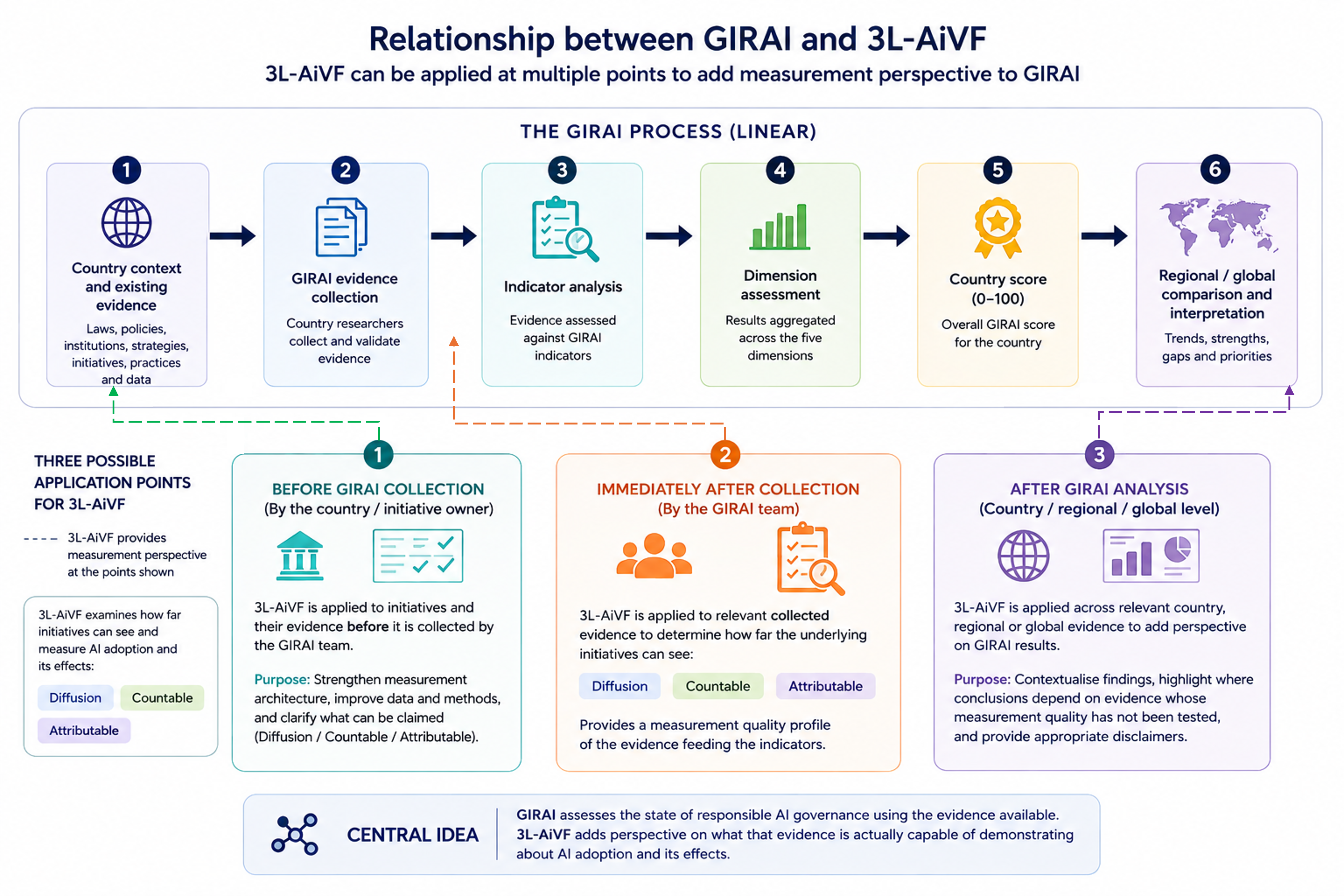
GIRAI and 3L-AiVF operate at different levels. GIRAI assesses countries and national governance conditions. 3L-AiVF assesses an AI or smart-technology initiative and its measurement architecture. It asks whether the initiative can see its influence at the level of Diffusion, identify and count adoption at the Countable level, or credibly connect its intervention, adoption and resulting effects at the Attributable level.
A national strategy, programme or other relevant government initiative observed by GIRAI could therefore be assessed separately with 3L-AiVF. The purpose is not to rescore GIRAI. It is to examine the measurement quality of some of the initiatives sitting beneath the country-level findings.
Importance of Impact assessment
The connection between GIRAI and 3L-AiVF is especially useful around GIRAI's Impact Assessments indicator. GIRAI examines whether governments have frameworks and implementation mechanisms for assessing the impacts and risks of AI systems. 3L-AiVF examines whether an individual initiative's measurement architecture can connect identifiable AI use and intervention to measurable effects with sufficient evidentiary strength to support attribution.
GIRAI assesses the governance environment in which AI exists and operates. 3L-AiVF assesses the measurability of AI adoption and its effects through the initiatives intended to influence them.
GIRAI can therefore tell us whether impact assessment is embedded in a country's governance architecture. 3L-AiVF can examine whether particular initiatives (including governance initiatives) have the data and methods needed to demonstrate their claimed influence.
Where those initiatives are governance initiatives, the two frameworks intersect.
Better evidence can travel upwards
Used by governments during initiative design, 3L-AiVF could strengthen the evidence generated by the policies and programmes that GIRAI later observes. Used by GIRAI, 3L assessments could provide supplementary qualitative evidence, or eventually a structured indicator, for interpreting country results.
Good AI governance requires more than commitments and implementation. It also requires the ability to see what those initiatives change, and to substantiate the effects they claim.

Penias Pen Chabwela (NWU South Africa PhD Candidate — Economics) is a development economist and international development consultant with over two decades of experience in economic development, private sector development, public policy, strategy, institutional strengthening, monitoring and evaluation, and organisational development. He has advised governments, development partners, regional organisations and the private sector across Africa, and writes about the ideas shaping the future of development.